

Welding Extract Systems: Why Your Workshop Can't Afford to Ignore Fume Safety

Walk into any welding bay and you'll notice it straight away — that sharp, metallic smell hanging in the air. It's easy to get used to it. Most welders do. But that smell is a sign of something far more serious than an unpleasant working environment. It's a sign that airborne metal fume is building up, and breathing it in day after day can cause real, lasting harm.

That's exactly why welding extract systems exist, and why getting one right matters more than most workshops realise.
What Is a Welding Extract System?
A welding extract system is essentially local exhaust ventilation (LEV) built specifically for welding fume. Rather than relying on open doors, ceiling fans, or general workshop airflow to clear the air, an extract system captures fume right at the source — close to the arc, before it has a chance to spread and get breathed in.
In the UK, this isn't just good practice. The Health and Safety Executive (HSE) has classified welding fume as a carcinogen, which means employers have a legal duty to control exposure, not just manage it after the fact. A proper extraction system is often the difference between compliance and a serious fine — or worse, a genuine health risk to your team.
Why Fume Extraction Matters More Than People Think
Welding fume contains a mix of fine particulates and metal oxides, and depending on the material being welded, that can include manganese, chromium, nickel, and other substances linked to lung damage, occupational asthma, and long-term respiratory disease. The particles are small enough to bypass your body's natural defences and settle deep in the lungs.
The tricky part is that the effects aren't always immediate. Someone can weld for years without symptoms, then develop chronic health issues later in life. That delay is part of why fume extraction gets overlooked — the risk doesn't feel urgent until it is.
A well-designed extract system removes that risk at the point it's created, protecting welders without slowing down the work they're doing.
Choosing the Right System for Your Workshop
Not every welding bay needs the same setup, and that's where a lot of businesses go wrong — buying whatever's cheapest rather than what actually suits their space. A few common options include:
On-torch extraction, where the fume capture is built directly into the welding torch, ideal for MIG and flux-cored welding.
Fixed extraction arms, which sit above or beside the workstation and can be repositioned as needed.
Portable extraction units, useful for smaller workshops, mobile welding, or sites without fixed ductwork.
Downdraft or backdraft benches, which pull fume away from the operator across the whole work surface.
The right choice depends on the type of welding you do, the materials involved, how often the space is used, and whether you're working in a fixed bay or moving between sites. A quick site assessment usually makes the decision much clearer than guessing from a catalogue.
What About a Lab Fume Cupboard?
It's worth pausing here, because this is a question we get asked a lot, and it's easy to confuse with welding extraction — a lab fume cupboard is a different piece of equipment entirely, though it works on a similar principle of containing hazardous air at the source.
A fume cupboard is an enclosed workstation used in laboratories to safely contain and extract fumes, vapours, and airborne particles released during chemical handling, sample preparation, or experimental work. Unlike a welding extract arm, which pulls fume away from an open area, a fume cupboard physically encloses the work on three sides, drawing air in through the front opening (the sash) and venting it away from the operator through a dedicated extraction system.
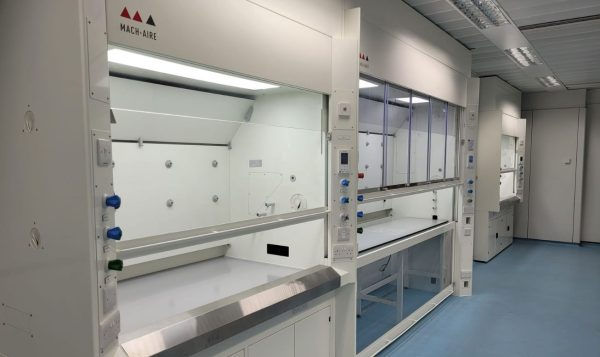
Fume cupboards are essential in settings handling volatile chemicals, acids, solvents, or biological samples, where even brief exposure can be hazardous. They're built to strict standards — covering airflow velocity, sash design, and alarm systems — because a poorly performing fume cupboard is a genuine safety failure, not just an inconvenience.
So while welding extract systems and lab fume cupboards both exist to protect people from what they're breathing, they're designed for very different environments and risks.
Getting Extraction Right, the First Time
At Ventxlabs Ltd, this is the kind of work we focus on every day — helping workshops, labs, and industrial sites choose, install, and maintain extraction systems that actually match how they operate. Whether that's a welding bay that needs proper LEV coverage or a laboratory that needs a compliant fume cupboard, getting the specification right from the start saves a lot of hassle (and risk) down the line.
If you're not sure what your space needs, it's worth getting a proper assessment rather than assuming one system fits all. You can find out more about our extraction solutions at ventxlabs.co.uk.
Frequently Asked Questions
1. Is welding fume extraction a legal requirement in the UK?
Yes. HSE guidance requires employers to control exposure to welding fume using suitable extraction, as it's classified as a carcinogen.
2. What's the difference between LEV and general ventilation?
LEV captures fume at the source before it spreads, while general ventilation (like open windows or fans) simply dilutes fume in the wider air — which is far less effective and not considered sufficient on its own.
3. How often should a welding extract system be inspected?
LEV systems typically need a thorough examination and test at least every 14 months, though some environments require more frequent checks.
4. Can one extraction system work for both welding and lab use?
No. Welding extraction and lab fume cupboards are designed for different hazards and airflow requirements, so they aren't interchangeable.
5. How do I know what size extraction system my workshop needs?
It depends on your welding volume, materials, and workspace layout — a site assessment is the most reliable way to get an accurate recommendation.


Comments